

How Care Changes Dads’ Brains – and What That Means for Alloparents
“Attunement to a small person's needs is there in anyone, ready to get unlocked.”

There’s not much social science research out there about alloparents. Here’s where you tend to find us: in biological research about the animal kingdom (elephants, whales, birds, primates – lots of aunties!) and in anthropological research about hunter-gatherer societies (arguably our best windows into how early humans lived). But research on everyday aunties helping to raise our loved ones’ kids in modern societies? Not so much. I’m always on the lookout.
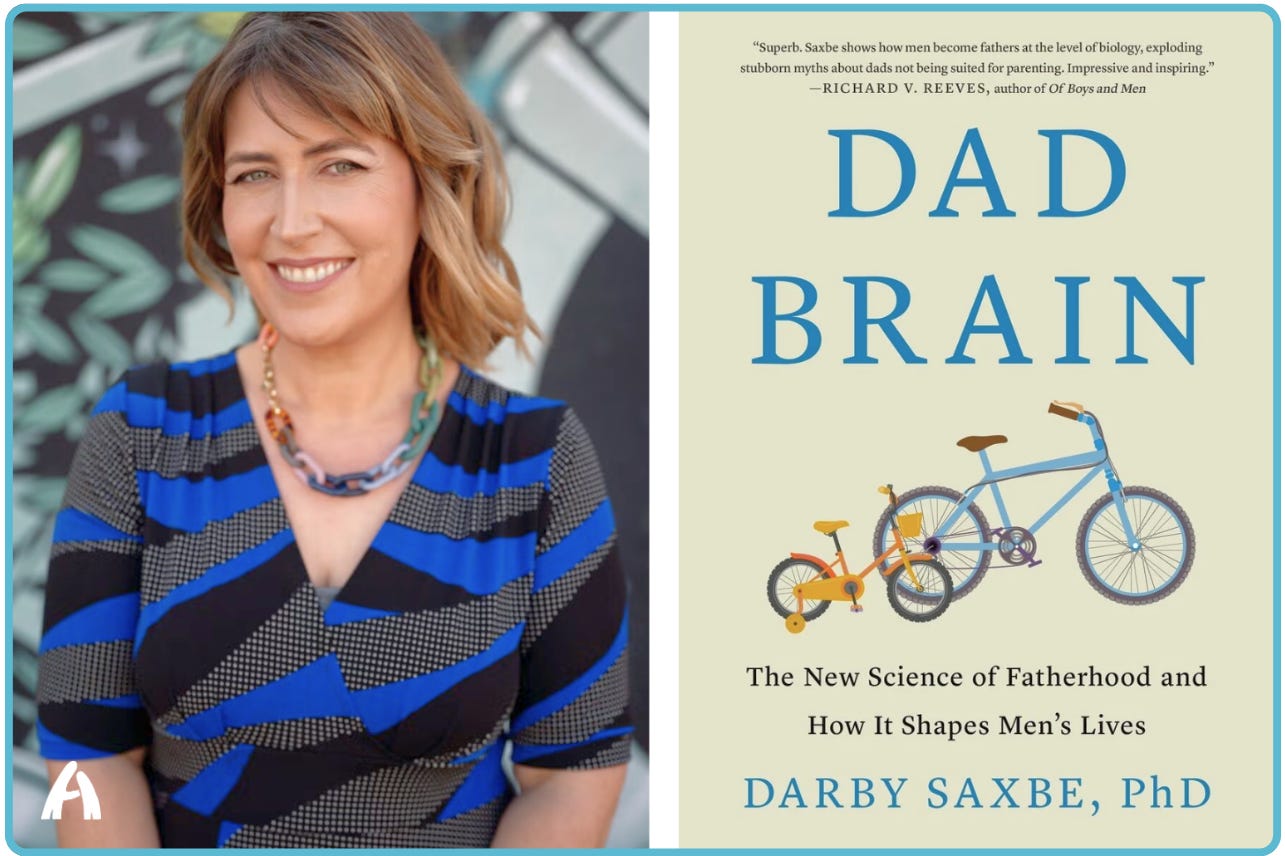
This is why I’ve been so excited about USC psychologist Darby Saxbe’s new book, Dad Brain: The New Science of Fatherhood and How it Shapes Men’s Lives. The book isn’t directly about alloparents, obviously, but it does have clear implications for us aunties. Darby and the folks in her lab have spent the last several years talking to new dads and taking neuroimages of their brains, and they’ve discovered that caring for a child actually changes the architecture and chemistry in there. Indeed, the more that new dads talk like invested primary caretakers, the more their brains start to look like those of biological mothers. “Biological pregnancy can help,” Darby says, “but it’s not a requirement for us to feel a connection to a baby.” Apparently it’s not a requirement in causing our brains to rewire for caring connection, either.
It turns out that engaging in care doesn’t just change our hearts; it changes our physiology – whether or not we have a biological relationship to the people we’re caring for. Feels accurate, right??
Lisa Sibbett: So Darby, do you call yourself a psychologist or a neuropsychologist or what? Can you give us a brief orientation to the intellectual domain you work in?
Darby Saxbe: I’m trained as a clinical psychologist – I got my PhD from UCLA – but I also identify as a health psychologist, which draws on biology and physiology, and a developmental psychologist, because I’m really interested in children and families. I’m in the psychology department at USC, with a joint appointment in the neuroscience department, and I’m affiliated with our neuroimaging center. I didn’t primarily train as a neuroscientist; I did my postdoc at USC, and that’s where I learned neuroimaging data collection and analysis.
Lisa: I don’t really think of neuroimaging as a psychology thing, per se.
Darby: There are a lot of neuroscientists hanging out in psychology departments, because neuroscience is one of those fields that universities don’t quite know where to put. I always say I’m not really an “axons and neurons” person. I’m more interested in using neuroimaging to ask questions about human thinking and behavior.
Lisa: It’s so interesting. My sense of what psychology researchers do has really been widened by reading your newsletter.
Darby: Good, I’m glad! Psychology is one of those fields where this might sound self-aggrandizing, but our department actually wrote up a description calling psychology a “hub science.” It draws on insights from physiology, public health, anthropology, sociology – there’s so much that can go under the umbrella because it’s really just the study of human behavior. And as humans, what’s not to like about that?
Lisa: It’s our favorite topic!
Darby: And I feel like psychology frequently doesn’t get taken seriously as a discipline, because people hear about psychology research and think, “well, I could have come up with that.” I remember feeling that way as an undergrad: it just seemed like fancy jargon for things that were intuitively obvious. But what makes psychology interesting is how you study it: coming up with clever ways to get under the skin, to look at hormones, to look at the brain. How do you capture human behavior beyond just asking people?
Lisa: But some of your findings have been more intuitive than others.
Darby: Yeah, and that’s where you get excited – the parts that surprise you. A study can seem like it should produce an obvious result, and then it doesn’t. And you think: “Either something’s wrong with my data or something’s wrong with my assumptions.” Usually it’s both.
I’ve always been interested in stress within families, and in using methods like stress hormones and brain imaging to try to get under the skin of how we influence each other – how we shape each other’s brains and physiology in close relationships. As a postdoc, I worked in a lab focused on teenagers, and I did a brain-scanning study where we showed teenagers videos of their parents and looked at where in the brain they were responding, linking that to their closeness to their parents. How do our relationships get reflected in our neurobiology?
When I was starting my own lab, I was thinking: I’m interested in families and parents and kids and relationships, and how we connect to each other. If you want to intervene to help kids and improve their outcomes, where can you have the most leverage? That initial transition to first-time parenthood can be an inflection point – it can create mental health risk, relationship strain – so maybe hone in on that transition and look at what’s happening in our neurobiology. And I got interested in dads because I think they’re understudied, and yet there’s all this evidence that they’re also showing brain and hormone shifts around the transition to parenthood. That was the initial spark. I started my lab in 2013, so it’s about thirteen years that I’ve been doing this longitudinal study.
Did you know The Auntie Bulletin is now available via Ghost? Learn more here.

Lisa: So tell us about the Dad Brain book!
Darby: The book is about how fatherhood transforms men across a variety of different domains. What does it do to their brains? What does it do to their hormones – specifically testosterone, but also oxytocin and prolactin? What does it do to their relationships? How does fatherhood affect the couple relationship? How do dads engage uniquely in the parenting relationship? And how does it affect their health?
I have a chapter on mental health and a chapter on physical health, where I talk about things like dad bod and sleep deprivation in new dads. The first half of the book is called “The Science of Fatherhood” – what fatherhood changes in men and through what pathways. The second half is called “The Practice of Fatherhood,” and it’s more based on talking to dads about their experiences of how fatherhood has shaped their lives. I have chapters on step-parenthood, adoption, trans parenthood, how men engage in fatherhood after incarceration or separation, and how dads navigate workplaces and society. What is our policy infrastructure for supporting fathers? It’s everything about fatherhood that I could fit into one book.
Lisa: Wow, I didn’t realize you were being that ambitious!
Darby: It sort of took on a life of its own. It was initially focused more on my research, but it’s such an interesting and rich topic that I ended up wanting to bring in a lot of pieces. Fatherhood is so dynamic within contemporary societies. Men’s engagement in fatherhood has changed a lot, and there’s a lot of variability across different men and different cultural contexts. Fatherhood is an interesting phenomenon that converges biology and culture. You have to talk about the biology and the evolution, but you also want to talk about policy, the workplace, cultural values – so it’s a lot. That’s why it took me so long to write it!
Lisa: So what does happen to dads’ brains?
Darby: We know from our own and others’ research on moms that the brain loses gray matter volume around the transition to first-time motherhood, and it loses it quite profoundly – you can train a machine learning algorithm to pick out, from a whole bunch of different scans, which ones belong to mothers and which ones belong to non-mothers across the same time span.
Lisa: Now, I’ve seen you give this caveat a few times: smaller gray matter volume doesn’t just mean you’re dumber now, right? Can you talk us through that?
Darby: Exactly. You often see this deficit framing around “mom brain.” It’s pejorative. People say, “I have mommy brain, I can’t keep track of things.” What’s actually probably happening is we’re sharpening our cognition to focus more on what’s salient. Some studies of moms have found they have better memory for baby-related stimuli and maybe worse memory for other things. What seems to be happening with reduced gray matter volume is more about making pathways more efficient – pruning and streamlining the brain to work better. That hunch is supported by the fact that where we see changes is in what we call the “mentalizing network,” which is the network that engages when we think about other people’s minds. It’s a network you need a lot when you’re taking care of a small, vulnerable person.
So we’ve seen in moms that there’s this reshaping, this remodeling. What happens to dads looks similar but more variable. This was a collaboration with a research group in Spain where we pooled scans from my lab and theirs – the dads they had scanned were partners of women from our original mothering brain study. And with dads, we found volume reductions in some of the same parts of the brain. Dads have more nuanced changes, but are still showing overall decreases in some of the same social cognition pathways.
Then I followed up on that collaboration by looking more closely at the dads within my own lab that we had scanned, because we had asked them a million questions. We found that when dads lost more gray matter volume, they were more likely to tell us during pregnancy that they felt more connected to their unborn child and wanted to take more time off after birth. Three months after birth, they reported spending more time with their child – especially time as primary caregivers – enjoying their interactions more, and feeling more bonded. The changes to men’s brains really seemed to track with their engagement in parenthood.
And yet, the same changes were also linked with dads’ postpartum depression symptoms, overall psychological distress, sleep problems, and anxiety. We saw the mixed bag of parenthood: upsides in the relationship with the baby, but also mental health risks that seem to track with that.
Lisa: So am I understanding right – this is my layperson’s summary – that the dads whose gray matter volume is being reduced, which seems to correlate with a more caring psychology, are just having a more mom-like experience?
Darby: That’s a good way to think about it. Not that there’s any one universal mom experience or dad experience, but the more that dads were more engaged in hands-on care, the more they showed some of the same mental health risks that are frequently associated with motherhood. Early parenthood is taxing and can be very isolating. Our society isn’t always well set up to support caregivers. And as dads engage more in that, they’re also experiencing some of the fallout. So the answer isn’t that men shouldn’t participate in parenting; the answer is we need to support our caregivers better through broader alloparental networks and better policies.
Lisa: Amen!
Now, my understanding is that you’ve found that, in birthing parents and moms, there are both architectural changes and hormonal changes. Are those separate categories, or is it the same thing?
Darby: They’re all related. We don’t really know for sure – are the hormone changes driving the brain changes, or are the brain changes affecting the hormones? It’s probably some bidirectional process. In moms who have a biological pregnancy, there are a lot of hormonal shifts associated with pregnancy, birth, and breastfeeding. But we also see heightened brain responses to infants in adoptive moms and in dads.
Human parenthood is complex, and this gets us into the alloparenting topic: we are designed to be flexible and adaptive. We can survive even if a primary biological parent goes missing because we have these big social brains that are built for us to take care of each other. Biological pregnancy can help, but it’s not a requirement for us to feel a connection to a baby.
Lisa: So what do you then conjecture about alloparental brains? If you had to make an educated guess, what would you expect to see?
Darby: I think you’d see really similar brain changes to what you see in dads. There’s actually a new study that looked at brain changes in grandmothers who were involved in caregiving – done by James Rilling at Emory – which found that they had brain changes that looked similar to moms, tracking with their level of involvement with the child.1
The way I think of it is: we are very plastic. Our species depends on the survival of infants who are born very immature and require a lot of care. The most adaptive way to be human is to have a set of caregiving faculties that can switch on when needed.
I was just talking to Elizabeth Preston, who wrote this new book The Creature’s Guide to Caring.
Lisa: Oh, I’m excited to read that.
Darby: It’s so good. We were talking about this quote from Ruth Feldman, who is an Israeli neuroscientist who’s done a lot of really interesting studies of parenting and the brain. The quote is something like: “the parent prefigured the human.”
Because we’re designed to keep our little creatures alive, we have all of these preset controls in our brain that make us empathetic, responsive, good at giving care. That equipment is in there regardless of whether it’s an adoptive child, a community member’s child, whether we’re the dad or the mom. That dial can turn to different levels of intensity, but we can switch it on because it’s an important part of being human. We’re not like giraffes, that can be born and just walk around and find their own leaves. We can’t even roll over in our first few months. We need a lot of hands-on help.
Lisa: It’s so fascinating. I feel like there are a lot of people in the world who believe they don’t have a caring faculty, that caretaking just isn’t in them.
Darby: Honestly, that’s one reason I wanted to write this book. I especially see that around gender essentialism. You see all this stuff about how moms are designed or wired to care, and dads should just be out at the office. It’s based on this understanding that you have this built-in skill set or propensity, and the part that gets missed is that it’s a more universal feature of being human than it is a property of just the biological mom. The biological mom’s dial gets turned up higher, but that attunement to a small person’s needs is there in anyone, ready to get unlocked.

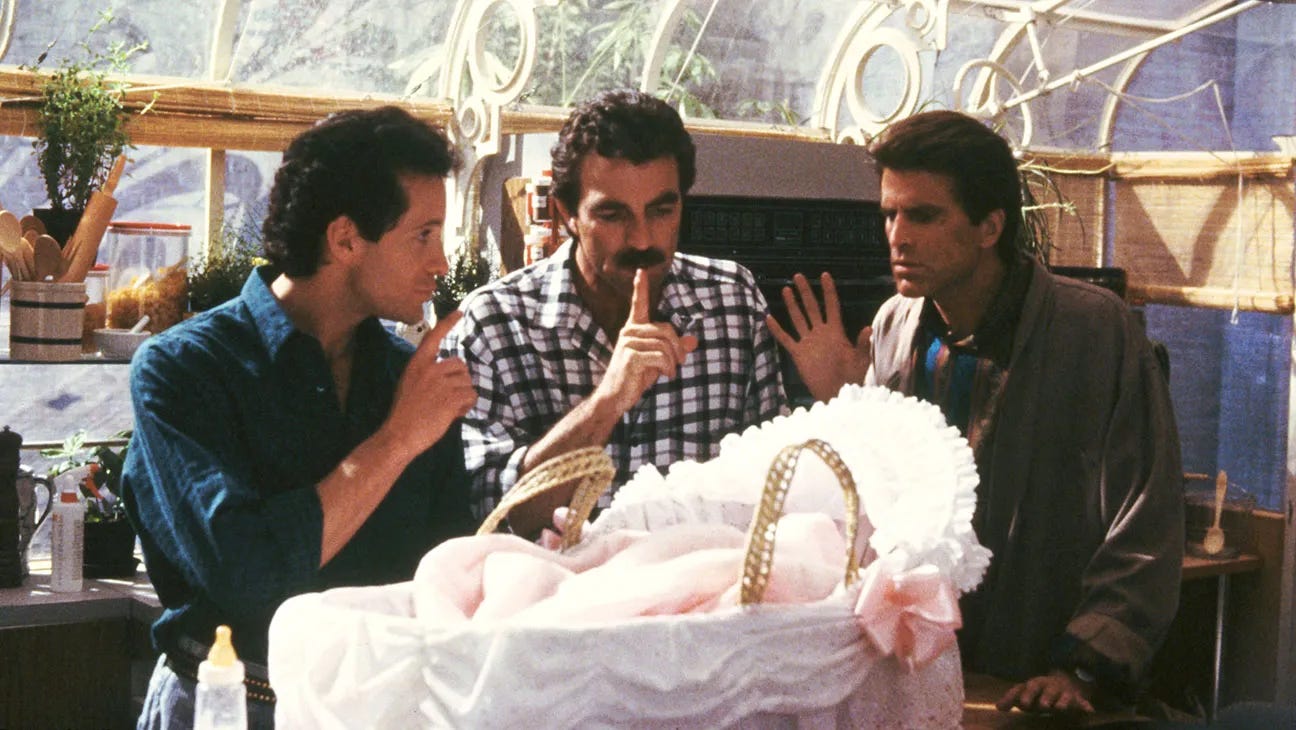
In fact, it’s the premise of a lot of great movies and TV shows. I talk a little bit about the Mandalorian – you’ve got this tough warrior who all of a sudden has to take care of Baby Yoda. And The Last of Us is another good example. I think we find those stories of unlikely bonding really appealing, because they tell us something about this layer of our humanity that we don’t always tap into. Or Three Men and a Baby. There’s this whole genre of men taking care of children that almost seems more prevalent in pop culture than in everyday life.
Lisa: It’s my mom’s favorite genre! Especially if the caretaking man is initially grumpy.
This is also making me think about care for elders and adults – people with disabilities and people who are sick. I spent a couple of years being a primary caretaker for my grandmother. She was having pretty significant dementia and increasingly needed a lot of care, and I just noticed this increasing shift – this massive tenderness in my heart for her, that felt like a product of that care.
Darby: I was just reading – I’m only partway through it – the book Essential Labor by Angela Garbes.
Lisa: I love her books.
Darby: She talks about being of Filipina heritage, and this legacy of caregiving – basically importing nannies and elder care aides and nurses – and how that reflects our devaluation of care, our desire to essentially underpay workers from overseas. But I thought it was really interesting that she also takes a very positive frame on care and how important it is.
I think you and I will agree on this: if there’s anything we can do to realign our society to make it a healthier one, it’s about how we value care, and how much we center it as a really essential part of a good society.
Lisa: I mean, I think it honestly might be the difference between humanity surviving or not.
Darby: And to me, it feels like the only act of resistance in a pretty discouraging world: what are the networks we can build with our neighbors, with kids, either our own kids or kids in need or kids in the community? How do we form stronger ties? I really believe that’s how we will create a better world. Out of the ashes of this one.
Darby Saxbe’s newsletter is Natal Gazing and her book, Dad Brain: The New Science of Fatherhood and How it Shapes Men’s Lives, is out June 9.
Nothing Sold, Bought, or Processed
The Auntie Bulletin is an ad-free, feminist, anti-capitalist publication that will never try to sell you anything. We donate 100% of affiliate revenue from Bookshop.org to organizations supporting vulnerable kids. Now through (at least) June, we’re supporting NICWA, the National Indian Child Welfare Association. Learn more here.
Thank you so much for your support. This newsletter literally could not exist without you.
I think Darby was talking about this new study by James Rilling and colleagues, but since most of us probably aren’t conversant in OXTR DNA methylation – whatever the heck that is – we can check out this earlier popular science write-up of their research on grandmothers.