
How To Run a Functioning Society
Good ideas for manifesting the cozy revolution, courtesy of the Auntie Collective

First, Two Announcements
Free School Choice Workshop. On Wednesday 1/28 at 7pm Pacific, my research partner Stephanie Forman and I will join the Seattle chapter of Integrated Schools to explore prevailing social narratives about public versus private school and how on earth parents can choose. This workshop focuses on the Seattle education context, but has applicability to other regions, too. It’s on Zoom, and it’s free!
Congrats, Charlotte! Charlotte upgraded to a paid monthly subscription to The Auntie Bulletin and won our recent drawing for a free year of this newsletter. She’s receiving full access to all essays – which, going forward, will be partially paywalled. Discussion threads like today’s, Such Interesting Auntie profiles, interviews, and monthly links roundups are now free for all readers.
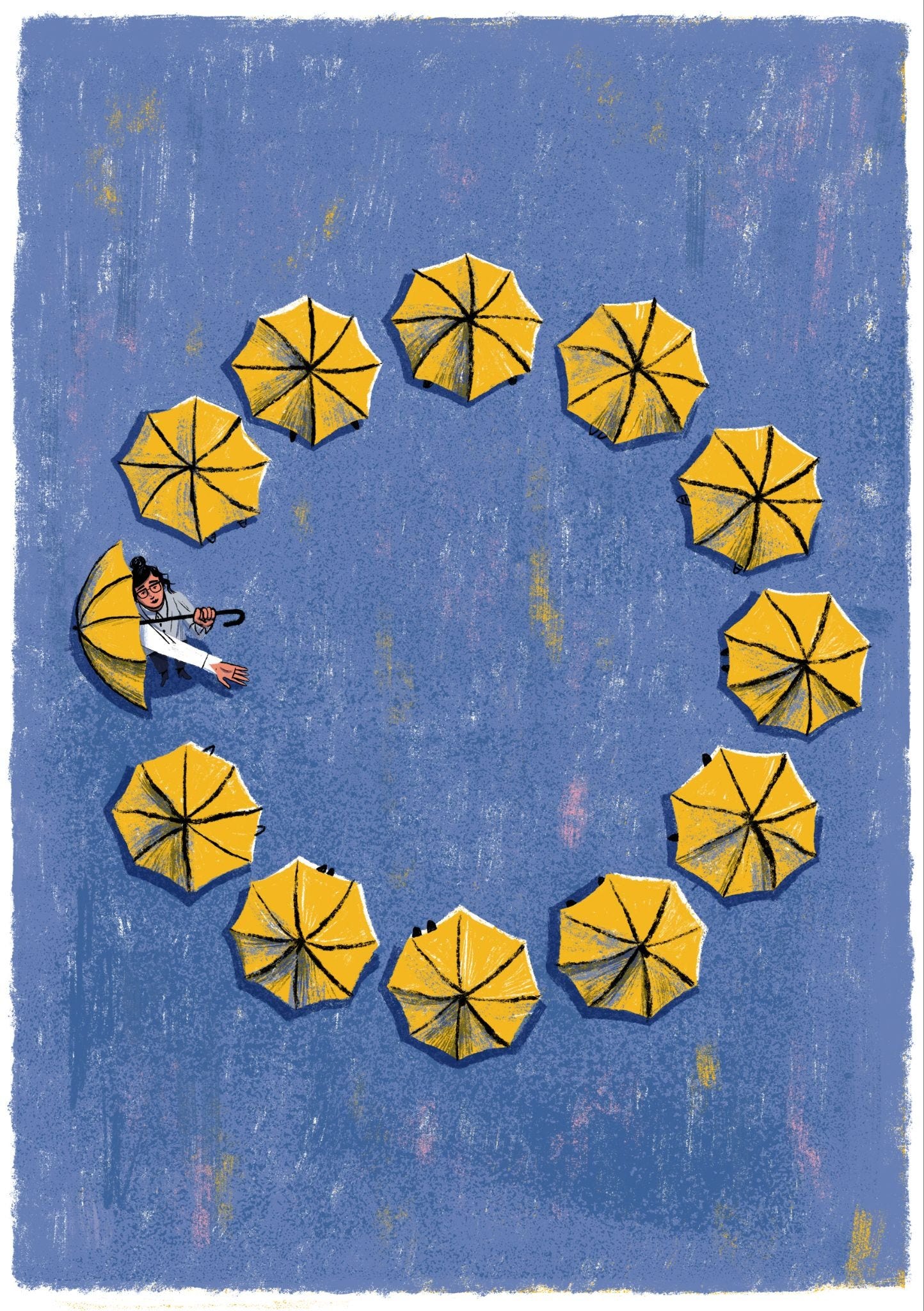
“I can’t think of anything more interesting or important than inventing new worlds… [and] questioning the assumption that we are stuck with this one as it is.” – Brian Eno
Last week at The Auntie Bulletin, I described the political project of Auntiehood as a cozy revolution – a way of relating to other people’s kids, other people’s elders, and other people’s people that’s welcoming, friendly, and quietly radical. By modeling how else things could be and welcoming others in, cozy revolution helps transform culture for the better.
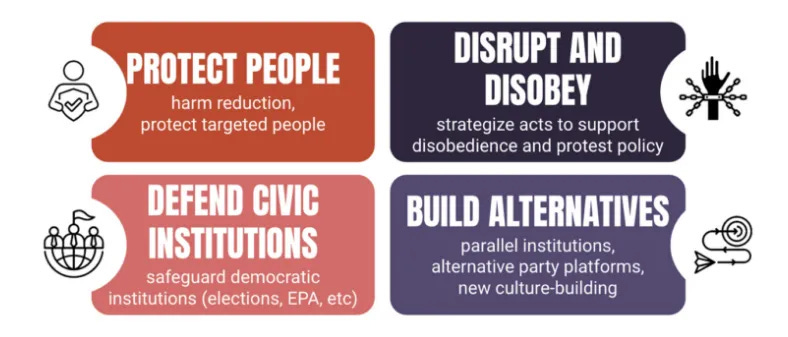
Let me quickly situation this orientation in the context of larger, ongoing efforts for social change. Choose Democracy has helpfully outlined four different roles people can play in cultivating a more loving, inclusive society: 1) help protect vulnerable people and groups; 2) defend civic institutions like schools or departments of public health; 3) disrupt unjust policies and disobey unjust laws; 4) envision and help build sustainable alternatives. All of these roles are necessary and important, and they often overlap. I’m confident you can think of examples of each.
Here at The Auntie Bulletin, we’re all in on envisioning and building alternatives. I don’t know about you, but I don’t really have what it takes to respond to each new catastrophe as it arises. What I can do, though – and I bet you can, too – is keep steadily banging the drum for the world we want to live in. We Aunties and those who love us can slowly, purposefully, and lovingly change the cultural narrative about what’s possible so that two or twenty or two hundred generations from now, all people might be able to live well-supported by their communities, free from exploitation, in a clean, safe, and healthy world.
This week, Aunties, let’s dream big. Let’s spend some time envisioning, as concretely and specifically as we can manage, the kind of world we want to live in. And let’s not concern ourselves too much with feasibility. Our culture teaches us to be skillful at naming what we don’t approve of, but doesn’t really support us to become strong imaginers of alternatives. Maybe we’re doing a little magic wand thinking here, but this form of magical thinking is important. The more we describe the world we want to live in, the more we can work toward it.
For today’s discussion, I invite you to think about your own domain: the places in the world that you know and love, your profession, your life circumstances. What would make life more functional, more loving, and more humane in your little slice of the social and/or natural world? How could we be doing things differently and better? Like, if you’re a public librarian, what would you do with a fully-funded libraries budget? If you work at a big tech company, how could that company better prioritize people and the planet? If you’re a foster parent, what do foster kids and foster families most need?
I’ve been planning this discussion thread for a while now, so I’ve had time to think and gather examples. Here are some ideas, from me and others around the internet, to spur your thinking:
The work week should be shortened by, say, 5 hours, and everyone should be expected dedicate their recovered time to care work. This would lighten the load on parents, those caring for adult family members, and paid careworkers alike. (How would this actually work? No idea! We’re waving our magic wands!)
At age 18, young people should be drafted into civil service for one or two years. Everyone gets to choose what field to serve in – it just has to benefit society in some way. They receive job training, life experience, and most importantly, training in empathy and what matters. Can you imagine how society might change if all of us offered a sustained period of service to the public good?
Here in the U.S., we need a national holiday on Election Day, and voting should be compulsory. Let’s be more like Australia!
If Kelton Wright were fantastically wealthy, she would pay everyone in her community’s emergency vet bills.
Courtney Martin, imagining a politics that honors the truth of our mortality, envisions “far less punditry and hot takes and far more poetry and silence.”
Laura Fenton suggests we should bring back bartering.
Auntie Bulletin reader Theresa wrote a lovely comment on the cozy revolution post about the carpool she recently started with her neighbors. They take turns driving kids to and from school, which gives all of the parents more time to themselves and more time caring for kids who aren’t their own. Parent creators on Substack and elsewhere should throw all their weight and influence behind building a family carpooling movement in 2026.
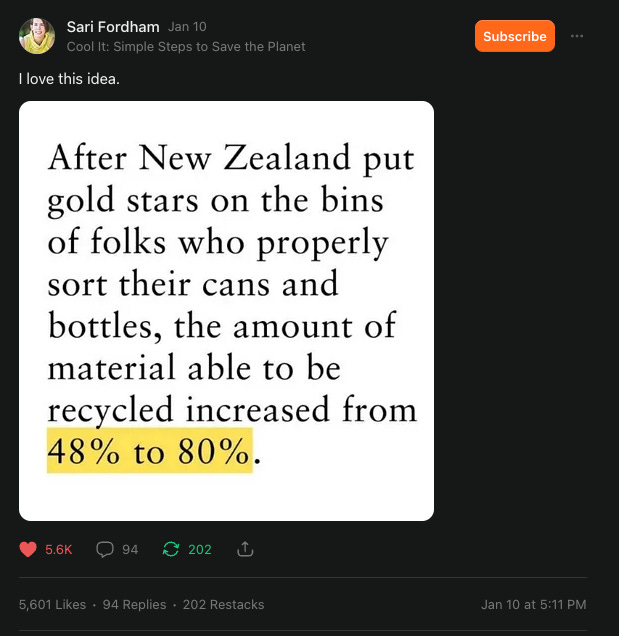
Your suggestions do not need to be fully baked; they don’t even need to be your own. What specific, concrete have you come across that resonate? Feel free to share links.
One last note: let’s avoid trying to magic wand our enemies away. Maybe we can think of ways to rehabilitate and reintegrate them as functioning members of society; maybe we can just identify ways to distract them and keep them out of trouble.1
I can’t wait to read your suggestions, your big dreams for the world we want to live in. I hope y’all will respond to one another’s ideas as well. The more of us chime in with our ideas – however big, small, realistic, or otherwise – the more of a badass blueprint for a functioning society we will generate.
Maybe: decommission ICE and get all the agents really invested in playing organized team sports for 8-12 hours a day. Also, instead of money, billionaires can have M&Ms and compete with each other for who can amass the most candy.
College student dorms would be run like intentional communities with shared resources (like cars and snowblowers) and structured time together (meals) and each dorm would be paired with a group of elders or children to pour into (afterschool care in the basement, visits to a nursing home with people they get to know for four whole years). People graduate with community skills and intergenerational connections and the local community benefits
I've had a few things come up in recent weeks that have gotten me thinking about conflict resolution/online moderation/de-escalation tactics and I feel like more people need to be trained somehow in these things to make our communities more open and functional. The people who are good at these things are really good and make it look easy, but I know it's not (especially as a naturally conflict averse person). For example, it is the difference between having a tool library shared between some friends who have shared trust and accountability, to opening up your tool library to your whole neighborhood and being equipped to not have everything collapse because one person hoards the tools